ICL 1900 Series Preservation
1830 General Purpose Visual Display Unit
|
Introduction The 1830 GP VDU can best be described as a mystery; actual ICL information about it is virtually non-existent, with only one version of TP4999 mentioning it as supported on the E4BM executive. That at least shows that it was included early on in the life of the 1900 series. What we now know (or think we know) about it has been obtained by various, mostly indirect means, starting from the existence of a package for the device in the EWGn GEORGE3/GEORGE4 executives. That this package exists in the Executives for the 1904A/S and 1906A/S series machines implies that it was a supported device throughout the lifespan of the 1900 series. What was it? It was a graphical display device, employing a vector display technique, where lines were drawn on a 10" x 10" cathode ray tube display by using software commands to deflect the spot to locations on the screen, which was addressed as a 1024 x 1024 grid. The beam could be switched off, or on with two brightness levels. In addition the device had a built-in character generator supporting a large range of displayable characters. An almost total absence of original information Despite the above, we have managed as a result of some discoveries of programs managed to determine both the PERI level programming interface, and to work out enough to create an emulator. The accuracy of this emulation is unknown, we cannot be sure of so many things, except for just under half of the displayable character set. The initial existence of the Executive package was of no use whatsoever without either a specification for the hardware, or some programming information. Some years ago (2014) we discovered three programs on an old magnetic tape: #PETE, #DISP and #XJV4 These were loaded and started under GEORGE 3 in a spirit of 'just see what it does' and when they halted with a 'GD' message, this eventually led to the realisation that the programs were for the 1830 GP VDU. A suitable Executive was compiled and the programs managed to pass the initial ALLOTs, but naturally failed as we had no (virtual) hardware on the system. This did, however allow the data to be written to the device to be seen in the PERI instruction's buffer areas. A crude simulator was added to the 1904S emulator to allow write transfers to complete, with the data written to a file for examination. With some work this allowed a (very) rough emulation to be created that managed to display text in a meaningful manner on a simple emulation of the device. These three programs on closer inspection were low-level programs which drove the device directly by PERI instructions. The programs are either simple demonstrations or simple go/nogo diagnostics. Due to time and other pressures, in addition to the paucity of information, the project was set aside. Galdor Gold During the latter part of 2016 some more magnetic tapes (ex-Galdor Computing) were obtained and
transcribed to emulator format by our colleagues at TNMoC. One of these tapes was an engineer's tape containing
a somewhat eclectic collection of test
and diagnostic programs including some (#NGDx) which we realised were for the 1830 GP VDU: It should be noted the ICL programs with names of the form #Nddx (as above) are engineering test programs and the two fields 'dd' and 'x' provide useful information as follows:
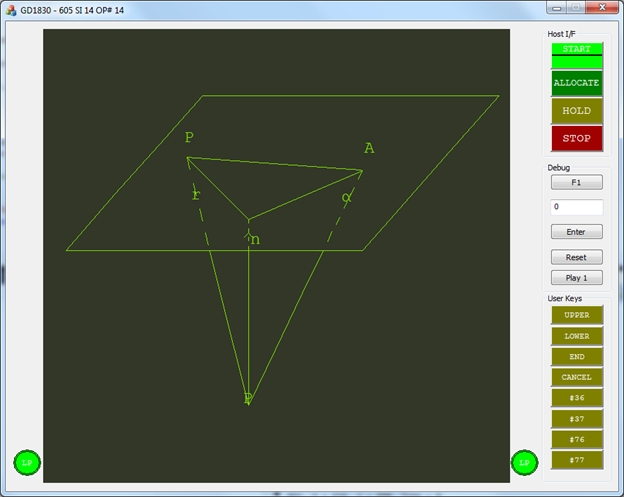
Examination and reverse-engineering of these programs led to the discovery of considerable insight into the workings of the device, which turns out to have been very full-featured, with abilities beyond anything that I can find on contemporary devices from the likes of Digital, IBM etc. It could display text in upper and lower case, with an alternate symbol set that included glyphsfor α, β, ° among about 90 others. In addition abilities to display fractions, super and sub-scripts and overwrites were available. It soon became apparent that these five programs all employed a set of routines which were identical. This was, we decided, most likely a subroutine library (written in PLAN) which we called S-GV from some hints in the documentation for #NGDC, which happens to be in one of the diagnostic program manuals on the website. More recently a copy of the ICT manual 'Visual Display' TP4094 appeared on the Centre for Computing History website, which vastly extended our knowledge of the capabilities of the device. Some of our guesses we shown to be quite accurate and others, total nonsense. See https://www.computinghistory.org.uk/det/14958/ICT-1900-Series-Visual-Display/ Unfortunately this manual only describes the use of the device from FORTRAN using a subroutine library. No information on the use of the device via PERI instructions in included. This led to the re-creation of the subroutine library, an exercise initially largely to re-create the library with the hope of finding out more about the operation of the device, which turned out to be a very productive project and is still actively being pursued. The screen shot below is of our 1830 emulator, possibly a complete travesty, we don't even know the phosphor colour(s), so I have picked a plain VDU green, likely this device had a medium to longish persistence, possible with distinctive colours. Does anyone know?
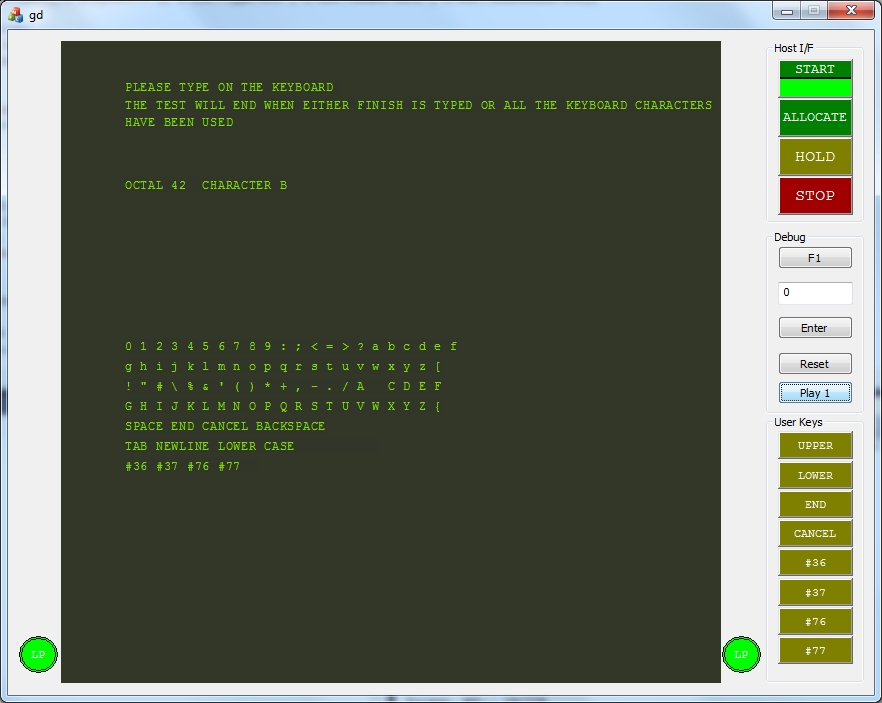
Test #4 from #NGDM
This test responds to each keystroke by obliterating the corresponding character or word in the table (e.g. the 'B' above). If the lightpen is activated the message in the upper part of the screen informs the user of the fact. Running this test appears to indicate that the keyboard was a rather simple device and the UPPER and LOWER buttons sending a code to the 1900 which had to be processed by the object program to indicate the case of subsequently typed characters. I.E. the key labelled '2' always sent the code #02, if you wanted to input " you had to press LOWER then '2' and then UPPER again, unless you wanted to input other characters from what we think of as the 'shifted' number keys. Generated 1830 Documents
Finally, an appeal for help We would really appreciate anyone with information regarding this device to contact us. Anything regarding it will be extremely useful, logic diagrams, specifications, programming information . Don't let Digital, IBM, Elliott, Imlac etc. be remembered for 1960's displays, ICT/ICL had one too. Also, who used these beasts? What for? We only know of a single site with one connected to an ICT 1909 at Recheninstitutes der Technischen Universität Berlin, which was possibly sent on to somewhere in Poland at an unknown date. Page last updated: 17-Feb-2026 |